
Oxygen is one of the most important utilities in a hospital. It supports critical care, operation theatres, emergency departments, ventilators, post-operative patients and many other areas where a continuous and dependable oxygen supply is essential. Because hospital operations depend on oxygen being available when it is needed, simply having cylinders or an oxygen source in place is not enough. Hospitals also need to know what is happening with their oxygen supply at any given moment.
Traditionally, oxygen cylinder banks and medical gas systems hFave been monitored through physical inspections, pressure gauges, manual records and communication between technicians, engineers and hospital administrators. These methods are familiar and remain important, particularly for physical inspection and maintenance. However, they also have an obvious limitation: a person cannot continuously stand beside the oxygen manifold and observe every change throughout the day and night.
This is where an oxygen cylinder monitoring system for hospitals can make a significant difference. Instead of relying only on periodic checks, a connected monitoring system can continuously collect important information from the oxygen system and make that information available to authorized users. This can include oxygen cylinder bank pressure, estimated oxygen quantity, outlet pressure, flow, oxygen purity and oxygen consumption, depending on the system configuration.
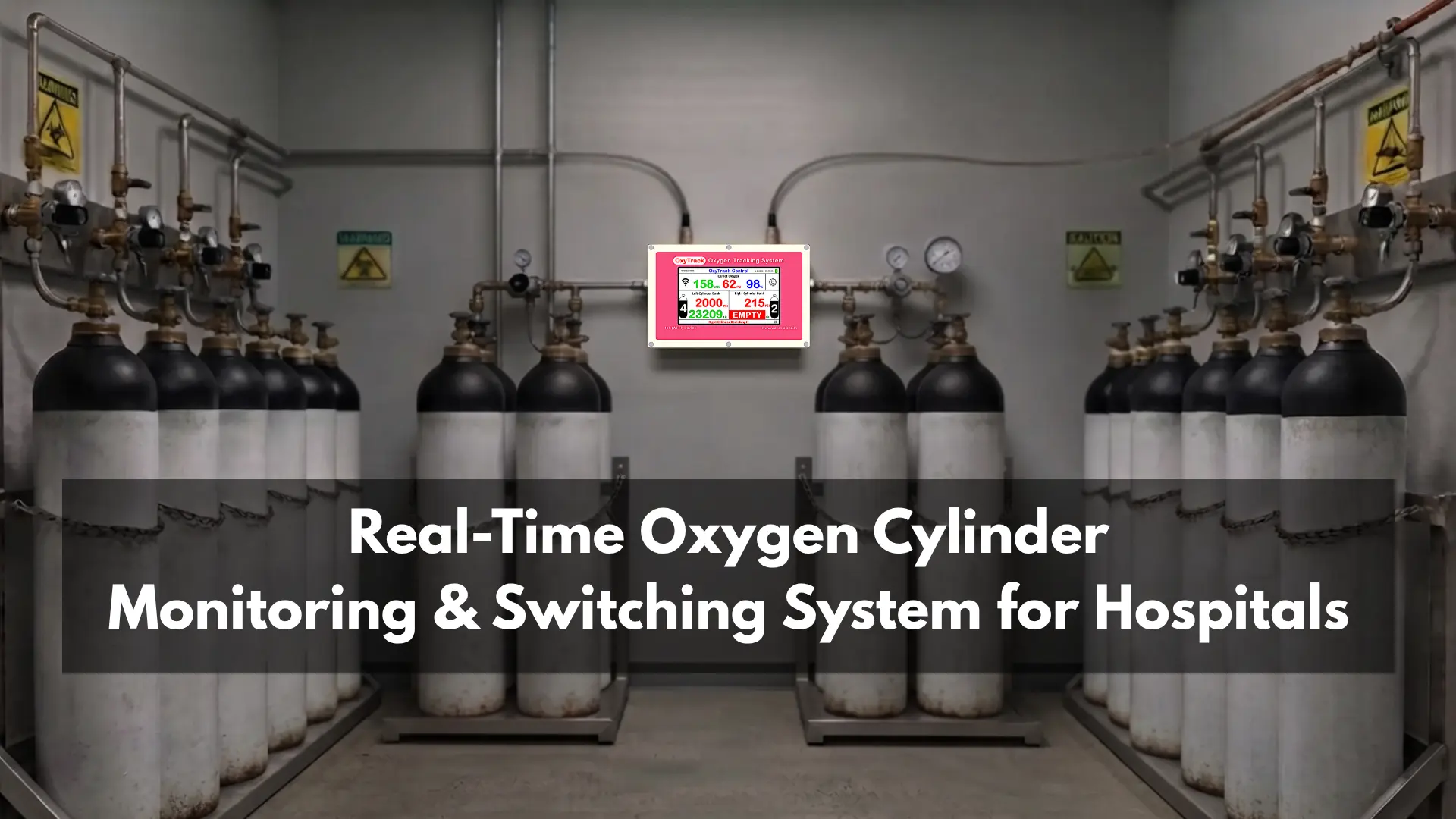
Wave Visions’ OxyTrack is designed around this approach. It provides live oxygen cylinder status monitoring and switching, allowing hospitals to view important oxygen parameters, receive configured alerts and review historical information through a connected digital monitoring system.
Why Is Oxygen Monitoring Important in a Hospital?
A hospital’s oxygen requirement does not remain constant throughout the day. Patient load can change, emergency admissions can increase, ventilators may be operating at different levels and operation theatres can create periods of higher oxygen consumption. These changes can happen during the daytime, at night, during weekends or when fewer engineering personnel are available.
When oxygen monitoring depends entirely on physical inspection, the information available to the hospital depends on when the last inspection took place. A technician may check the oxygen cylinder bank in the morning and find everything normal. Several hours later, the consumption pattern may have changed significantly. Unless somebody checks again, the hospital may not immediately have visibility into that change.
The problem is not necessarily the monitoring process itself. The problem is the gap between two manual checks. Hospitals operate continuously, but human observation is periodic. An oxygen monitoring system helps bridge that gap by continuously observing configured parameters and making the resulting information available digitally.
This creates a simple but important difference. Without continuous monitoring, the hospital may discover a change when somebody checks the system. With continuous monitoring, the system can provide visibility into what is happening between those physical checks.
The goal of an oxygen monitoring system is not to replace people. It is to make important oxygen-system information continuously available to the people responsible for monitoring and responding.
The Challenge of Manual Oxygen Cylinder Monitoring
Manual monitoring has been a part of hospital oxygen management for many years. A technician can inspect gauges, record readings and communicate the condition of the oxygen system to the relevant department. This physical involvement remains valuable because hospital infrastructure requires inspection, maintenance and technical expertise.
However, manual monitoring can become difficult when the hospital needs information continuously. Consider a situation where oxygen consumption begins increasing unexpectedly in the middle of the night. The change may occur shortly after a routine inspection. If nobody is continuously observing the oxygen system, the change may only become apparent during the next physical check or when the effect becomes noticeable through faster cylinder depletion.
This creates dependence on people, schedules and communication. Someone has to remember to check. Someone has to notice the change. Someone has to communicate it to the responsible person. Someone then has to investigate what happened.
A digital oxygen cylinder monitoring system can reduce this dependence for the monitoring and visibility aspect. The technical team is still required to inspect equipment and take action, but they do not have to rely only on periodic physical observation to know what the monitored parameters are doing.
What Does an Oxygen Cylinder Monitoring System Monitor?
The exact parameters available depend on the monitoring configuration. However, a hospital oxygen monitoring system can bring several important measurements together so that the hospital can understand its oxygen supply from more than one perspective.
OxyTrack is designed to monitor parameters including cylinder bank pressure, estimated oxygen quantity, outlet pressure, oxygen purity, flow and oxygen consumption. The system can also record historical information and provide configurable alarms for relevant monitored conditions.
This combination is important because a single pressure reading does not provide the complete picture of hospital oxygen usage. Knowing the current cylinder bank pressure is useful, but understanding how much oxygen is estimated to remain, how much oxygen is being consumed and how the consumption pattern has changed over time provides additional operational information.
Real-Time Oxygen Cylinder Bank Pressure Monitoring
Pressure is one of the most familiar parameters associated with oxygen cylinder banks. Traditionally, a technician physically checks the pressure gauge to determine the current condition of the bank. That information can then be communicated to the administrator or other responsible personnel.
With a connected oxygen cylinder monitoring system, the monitored pressure can be made visible digitally. OxyTrack supports cylinder bank pressure monitoring in the range of 0–200 bar or 0–3000 PSI, depending on the system configuration.
This can be particularly useful when hospital management needs a quick understanding of the current oxygen status without physically visiting the manifold area. Instead of asking someone to check the gauge every time information is required, authorized users can access the monitored status through the connected system.
Pressure monitoring therefore becomes more than a number displayed on a gauge. When it is connected to a digital monitoring platform, it becomes information that can be viewed, tracked and used alongside other oxygen-system parameters.
How Much Oxygen Is Available Right Now?
One of the most practical questions a hospital administrator may ask is simple: how much oxygen is available right now?
Without digital monitoring, answering this question may require somebody to physically inspect the cylinder bank, check pressure and estimate the remaining quantity. The information may then need to be communicated to the person who requested it.
OxyTrack provides estimated oxygen quantity monitoring, allowing the monitored oxygen availability to be represented digitally. The system can provide estimated quantity information for the monitored cylinder banks, helping users understand the current supply condition without depending entirely on a physical visit to the manifold.
This does not mean that physical verification is unnecessary. Rather, it gives the hospital an additional layer of information that can be accessed quickly when management or engineering personnel need to understand the current monitored status.
A useful monitoring system can help move the conversation from “Let me check” to “Here is the current monitored status.”
Why Oxygen Consumption Switching Matters
Knowing how much oxygen is available is only one part of oxygen management. Hospitals also need to understand how quickly that oxygen is being consumed.
Consider a hospital that knows it has a certain number of cylinders available. That information tells the hospital something about supply, but it does not necessarily explain the rate at which oxygen is being used. If consumption suddenly increases, the same quantity of oxygen may not last as long as expected.
This is why oxygen consumption switching can be valuable. Instead of looking only at how many cylinders were used, a hospital can begin looking at the pattern of oxygen usage over time.
OxyTrack is designed to switch oxygen consumption and provide historical information that can be reviewed across different periods. This can help hospital teams understand what is happening now and compare it with what happened previously.
For example, the hospital may want to understand whether oxygen consumption is higher today than yesterday, whether a particular week had unusually high demand or whether overall monthly consumption is changing. Historical data can provide a clearer basis for these discussions than relying only on memory or manual estimates.
Identifying Changes in Oxygen Consumption
A sudden increase in oxygen consumption does not automatically indicate a leak or equipment problem. There can be many legitimate reasons for increased oxygen demand. Patient numbers may increase, more ventilators may be operating, an operation theatre may be active or emergency requirements may change.
The value of continuous monitoring is that it can make such changes visible sooner. If oxygen consumption normally follows a particular pattern and then suddenly changes, the hospital has data that can be examined.
For example, imagine normal oxygen consumption is around 100 LPM during a particular period, but the monitored consumption rises to approximately 180 LPM. The monitoring system does not automatically determine why that happened. Instead, it gives the hospital a reason to investigate the change.
The engineering team can then consider the operational situation, patient load, equipment usage and other possible causes. This makes monitoring data an important starting point for investigation rather than a substitute for technical diagnosis.
Oxygen consumption data does not automatically explain the cause of a change. It gives the hospital visibility that can help the technical team investigate the change.
Monitoring Oxygen Pipeline Pressure
Monitoring the cylinder bank is important, but hospital oxygen management does not end at the cylinders. Oxygen must also reach the hospital’s pipeline system under the required operating conditions.
This makes outlet pressure another important parameter to monitor. OxyTrack supports outlet oxygen pressure monitoring with a range of 0–100 PSI or 0–7 bar, depending on the configuration.
By viewing cylinder bank pressure together with outlet pressure, the hospital can get a broader picture of the monitored oxygen system. Instead of considering only the source-side condition, the hospital can also observe the monitored condition at the outlet.
This integrated view can be particularly useful for engineering teams because oxygen availability and oxygen delivery are connected parts of the overall system. Monitoring multiple parameters together provides more context than relying on a single measurement.
Oxygen Flow Monitoring
Oxygen flow provides another useful indication of how the system is being used. Depending on the application and configuration, OxyTrack supports selectable flow monitoring ranges of 0–100 LPM, 0–200 LPM and 0–500 LPM.
When flow information is viewed together with pressure and consumption, it can help create a more complete understanding of oxygen demand. A hospital can see not only the condition of the oxygen source but also the monitored flow associated with the system.
This is particularly useful when the hospital wants to understand changes rather than simply record individual readings. Trends in flow and consumption can provide additional context for the engineering team when reviewing unusual operating conditions.
Oxygen Purity Monitoring
Another parameter that can be monitored through the appropriate OxyTrack configuration is oxygen purity. The system specifies oxygen purity monitoring across a 0–100% range.
Purity monitoring adds another layer of visibility to oxygen management. While pressure and flow provide information about the operating condition and movement of oxygen, purity monitoring provides information about the monitored gas quality parameter.
Continuous digital visibility can be useful between scheduled checks and can help users observe changes in the monitored parameter over time. However, digital monitoring should be considered part of the overall monitoring and quality-assurance process rather than a replacement for applicable testing, calibration or regulatory requirements.
Remote Oxygen Monitoring for Hospital Management
One of the biggest practical advantages of a connected oxygen monitoring system is remote access. Hospital management is not always physically present inside the hospital. An owner may be at home, travelling, attending a meeting or working from another location.
Yet the need for information does not disappear simply because the decision-maker is away from the hospital. A common question may still be: “What is the oxygen status right now?”
In a conventional process, the answer may require a series of phone calls. The owner may call the administrator, who contacts engineering, and engineering may then physically check the manifold before reporting the information back.
OxyTrack is designed to provide remote monitoring through mobile devices, PCs and laptops using Wi-Fi connectivity. This means authorized users can access the available monitoring information without necessarily being physically present beside the oxygen system.
Remote access does not eliminate the need for staff on site. Instead, it improves the availability of information for the people who need it.
Oxygen Monitoring Alerts for Faster Awareness
A monitoring dashboard is useful, but hospital staff cannot continuously stare at a screen. This is why alerts are an important part of a monitoring system.
OxyTrack supports adjustable high and low alarm limits for monitored cylinder bank and outlet pressure. When configured thresholds are crossed, the system can provide an alert to draw attention to the monitored condition.
This changes the monitoring process from simply checking data to being informed when attention may be required. The system can continue monitoring in the background while designated personnel respond to relevant alerts.
An alert should not be interpreted as an automatic diagnosis or a guarantee that a particular problem has occurred. It is an indication that a monitored parameter has reached a configured condition and may require human review and appropriate action.
Why Historical Oxygen Data Is Important
Real-time data tells the hospital what is happening now. Historical data helps explain what has happened over time.
OxyTrack records monitoring information and provides historical oxygen pressure and consumption information that can be reviewed over different time periods. This allows hospital teams to move beyond individual readings and examine trends.
For example, if oxygen consumption appears higher than usual today, historical data can help determine whether this is an isolated event or part of a longer-term pattern. Similarly, if consumption has gradually increased over several weeks, that information may be more difficult to identify through occasional manual checks alone.
Historical information can also support reporting and operational discussions. Instead of relying entirely on manually maintained records, authorized users can refer to the monitoring history when reviewing oxygen usage and system conditions.
A single reading tells you what is happening at one moment. A trend can help you understand how the system has been behaving over time.
Supporting Better Oxygen Planning
Oxygen planning becomes easier when a hospital understands both supply and demand. If management knows approximately how much oxygen is available but has little information about consumption patterns, planning can still depend heavily on experience and estimation.
Historical consumption information can provide additional context. Hospital teams can examine periods of high demand, compare consumption across different time frames and identify recurring patterns in oxygen usage.
This information can support discussions around supply planning and operational preparedness. It does not replace professional judgment, but it gives that judgment better information to work with.
The principle is simple: understanding oxygen consumption is an important part of understanding oxygen requirements.
Reducing Dependence on One Person
In many hospitals, oxygen monitoring can become closely associated with particular individuals. One technician may regularly check the system, another person may maintain records and a particular engineer may be the first person everyone contacts when there is a question.
This works when the right people are available. But people take leave, change shifts, move between responsibilities and may not always be immediately reachable.
A digital oxygen monitoring system can reduce the dependence on one person’s physical presence for basic monitoring visibility. Authorized users can access the same monitored information rather than relying entirely on one person’s memory or verbal update.
The technical team remains essential for maintenance, inspection and response. The difference is that monitoring information can become more system-dependent rather than being available only through an individual.
Better Visibility During Shift Changes
Shift handovers are another situation where monitoring data can be useful. A technician finishing a shift may tell the incoming technician that everything is normal. While this information is helpful, it does not necessarily show what happened during the entire shift.
With historical monitoring information, the incoming team can review the current monitored condition along with recent trends and relevant alerts. This can provide additional context during handover.
Instead of handing over only responsibility, the hospital can hand over visibility as well. This can make the transition between shifts more informed and reduce dependence on verbal communication alone.
OxyTrack: Connected Oxygen Monitoring for Hospitals
OxyTrack from Wave Visions is designed to provide hospitals with continuous oxygen cylinder status monitoring and switching. The system brings important oxygen parameters into a connected monitoring environment so that hospital teams can observe oxygen conditions without relying entirely on periodic physical checks.
Depending on the selected configuration, OxyTrack can monitor cylinder bank pressure, estimated oxygen quantity, outlet pressure, oxygen purity, flow and oxygen consumption. It also supports remote access, configurable alarms and historical monitoring data.
The system is available in different configurations to address different monitoring requirements. The OxyTrack range includes monitoring configurations as well as an advanced control configuration that can support automatic cylinder bank changeover control.
This allows the hospital to select a configuration according to its requirements rather than treating every oxygen installation in exactly the same way.
How OxyTrack Changes Hospital Oxygen Monitoring
The most important difference between conventional monitoring and a connected oxygen monitoring system is not simply the number of parameters being measured. It is the availability of information.
Without continuous digital monitoring, a hospital may depend on someone checking the system, recording information and communicating the condition. If a change occurs between two checks, that change may not immediately be visible to everyone responsible for oxygen management.
With OxyTrack, monitored parameters can remain visible continuously. Historical information can help users understand trends, configured alerts can draw attention to certain conditions and authorized users can access the system remotely.
This creates a shift from reactive visibility toward continuous awareness. The system does not make decisions on behalf of the hospital. Instead, it gives the people responsible for those decisions more information about what is happening.
Who Can Use an Oxygen Monitoring System?
An oxygen cylinder monitoring system can provide value to several groups within a hospital. Hospital owners and management can use remote access to understand the monitored oxygen status without being physically present at the manifold. Administrators can use current information and historical reports when reviewing hospital operations.
Engineering and maintenance teams can use monitoring information as an additional source of operational data when investigating changes in pressure, flow or consumption. Technicians can combine digital monitoring with their regular physical inspection and maintenance activities.
The result is a common source of monitored information. Different authorized users can refer to the same dashboard and data instead of receiving separate versions of the oxygen system’s current condition through phone calls or verbal updates.
The Future of Hospital Oxygen Management
Hospitals are increasingly adopting connected technologies to improve visibility across different areas of their infrastructure. Medical equipment, building systems and hospital operations can all benefit from having information available digitally.
Oxygen infrastructure is no different. It is a critical utility, and understanding its operating condition can help hospitals manage it more effectively.
The purpose of connected oxygen monitoring is not to eliminate technicians or physical inspections. Those remain important. Instead, the purpose is to complement existing processes with continuous digital visibility.
A technician can physically inspect the equipment. An engineer can investigate an abnormal condition. Management can make operational decisions. At the same time, the monitoring system can continuously provide information that helps those people understand what is happening.
Conclusion: Move From Periodic Checks to Continuous Visibility
Oxygen management is not simply about having cylinders available. Hospitals also need to understand the current condition of their oxygen supply, how quickly oxygen is being consumed and whether monitored parameters are changing over time.
An oxygen cylinder monitoring system for hospitals can provide this information continuously and reduce the dependence on periodic manual observation for basic monitoring visibility. By bringing together parameters such as cylinder bank pressure, estimated oxygen quantity, outlet pressure, flow, purity and consumption, a connected system can give hospital teams a broader view of their oxygen infrastructure.
OxyTrack by Wave Visions is built around this principle. It combines real-time oxygen monitoring with remote access, configurable alerts and historical data, helping hospitals move toward a more connected approach to oxygen management.
The real value is not simply having another digital display. It is having information available when it is needed. Instead of depending entirely on someone being present at the manifold, hospitals can give authorized users access to monitored oxygen information from connected devices.
Because oxygen systems operate continuously, their monitoring should also provide continuous visibility.
Without OxyTrack, you check your oxygen system periodically. With OxyTrack, your oxygen system can continuously tell you what is happening.
If your hospital is looking for a connected solution for oxygen cylinder monitoring, oxygen consumption switching and remote oxygen monitoring, OxyTrack can help bring these monitoring capabilities together in one system.
Learn more about OxyTrack and discover how real-time oxygen monitoring can improve visibility into your hospital’s oxygen system.